Walk into the commercial review meeting of almost any mid-size pharma company in India and you will find the same ritual playing out. Someone pulls up a primary sales report. Numbers look decent. Targets are green or close enough. The conversation moves to incentives, new product launches, quarter projections.
What nobody pulls up is what happened after the goods left the C&F agent. Whether the stockist actually moved the product to retailers. Whether the retailer pushed it to patients. Whether the scheme that was announced last month reached even half the intended counters. Whether expiry is quietly piling up somewhere in Bihar.
This is not a data problem in the traditional sense. The data exists. Stockists have it in their Tally or Marg or Busy systems. Field reps visit those counters. Distributors file monthly statements. The problem is that nobody has assembled it into something the head office can actually use in real time. And because of that gap, the most consequential decisions in pharma commercial operations are being made on primary sales data that tells you only what left your warehouse, not what is actually moving in the market.
Secondary sales visibility is not a nice-to-have reporting feature. It is the control lever. And in Indian pharma, most companies still do not have it in any meaningful form.
The Gap Nobody Talks About Openly
India's pharma distribution network is genuinely complex. A typical mid-size company with a few hundred crores in revenue runs through 30 to 50 carrying and forwarding agents, hundreds of stockists, and tens of thousands of retail pharmacies across geographies. Each of these entities operates somewhat independently, uses different software, reports differently, and has varying levels of digital readiness.
When something ships from the manufacturer to the C&F, that gets captured cleanly. Primary sales number goes up. Everyone is happy. But what happens after that is essentially invisible unless you have invested specifically in solving that visibility problem.
The stockist may be sitting on inventory he bought six months ago. He may have been given 90-day credit terms and is now struggling with cash flow, so he is not placing fresh orders even though retail demand exists. Your field rep visited 12 counters last week but only two of them have your product visible on the shelf because the stockist has not serviced the others recently. A scheme you launched in February is being claimed by stockists who are not passing it to retailers. Your near-expiry inventory in one zone is not being balanced against shortage in another.
All of this is happening below the primary sales line. And none of it shows up in the monthly MIS that goes to the CFO.
Why Primary Data Gives You False Confidence
The pharmaceutical industry in India has a structural incentive problem baked into how primary sales is measured. Because companies track shipments to distributors as revenue recognition, there is constant pressure to push goods into the channel. Quarter-end loading is common. Stockists get pushed to buy more than they can realistically sell. This creates what the industry quietly refers to as channel stuffing, and it inflates primary sales numbers while actual consumer offtake remains flat or even declines.
The downstream consequence plays out slowly. Stockists who are overstocked become reluctant to place fresh orders. Near-expiry goods accumulate. The company eventually has to take returns or write off inventory. The EBITDA hit from expiry and returns for a mid-size pharma company can easily be 5 to 7 percent of channel revenue, often more. And this is entirely predictable if you have visibility into what is actually sitting in the downstream network.
The bigger issue is strategic. If all your commercial decisions are being made on primary data, you are essentially navigating with a map of where you shipped product, not a map of where it ended up or whether it sold. Demand forecasting based on primary sales systematically overstates true market demand. New product introduction decisions get made on shipment velocity to distributors rather than actual prescription generation or consumer pull. Incentive plans reward field reps for driving stockist offtake, not for building actual retail presence or improving sell-through.
None of this is intentional mismanagement. It is just what happens when the data layer stops at the first mile.
What Secondary Visibility Actually Means in Practice
Let me be specific about what secondary sales visibility means, because it gets confused with basic distributor reporting.
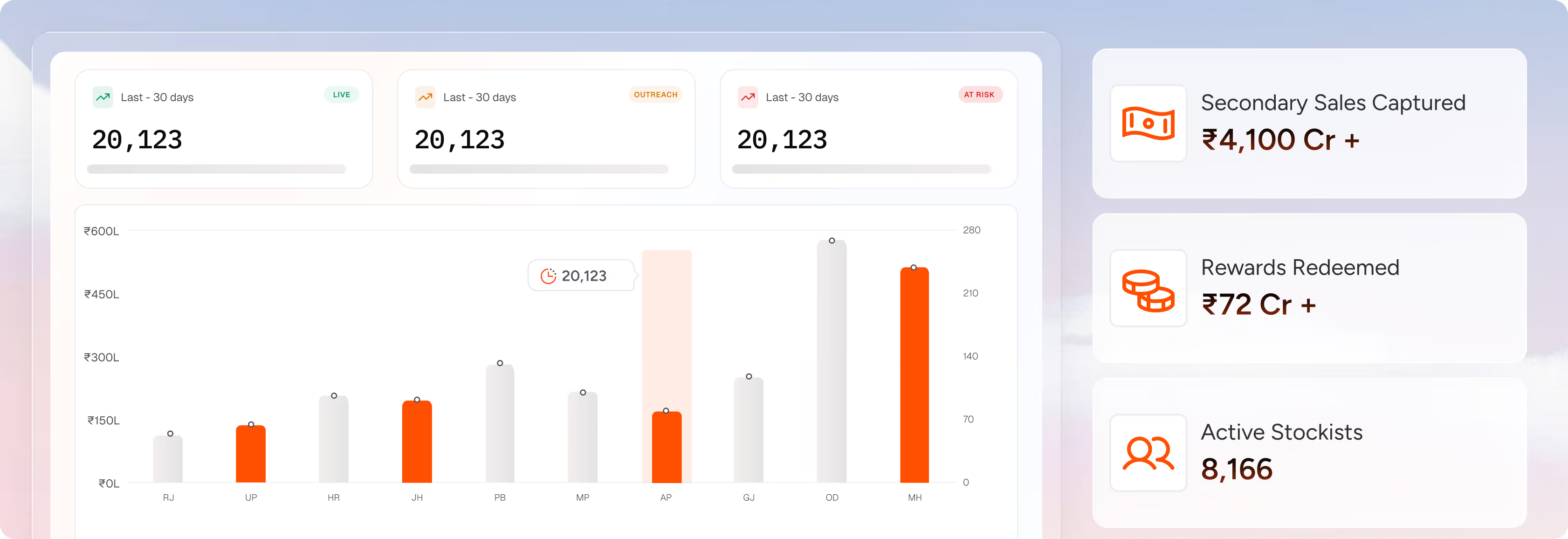
True secondary visibility means you can see, in near real time, the stock position at each stockist, the actual invoicing from stockists to retailers, which retailers are active in your network, what is selling and what is not moving at the SKU level by geography, and where inventory is building up relative to historical offtake patterns in that micro-market.
When you have that, several things become possible that simply are not possible otherwise.
You can identify near-expiry risk before it becomes a returns problem. If a stockist has three months of a particular SKU sitting in stock and his historical offtake rate suggests he will sell only one month's worth before the expiry date, you know that now, not six months later when he sends returns. You can proactively balance stock between stockists, push that SKU harder in adjacent territories, or negotiate a time-bound scheme to accelerate offtake. The 5 to 7 percent expiry EBITDA loss is not inevitable. It is a forecasting and visibility failure.
You can measure whether your trade schemes are actually reaching the intended beneficiaries. The gap between what a company spends on trade marketing and what actually reaches the retailer counter in India is well understood by anyone who has spent time in pharma distribution. Without secondary data, you have no way to verify whether a scheme designed for Class A retailers in Tier 2 cities is actually being claimed by those retailers or whether it is being absorbed higher up in the chain.
You can actually measure field rep productivity beyond call reporting. If you know which retailers are active, what their offtake looks like, and which reps cover which territories, you can link field activity to sell-through outcomes rather than just to the number of doctor calls or stockist visits logged in a CRM. This changes the entire performance conversation.
You can make better decisions about where to invest. Which micro-markets are growing, which are flat, which are declining. Which SKUs have genuine pull versus which are being pushed through discounts. This kind of intelligence is the foundation of any serious commercial strategy, and it requires secondary data.
Why This Problem Has Persisted So Long
If secondary visibility is this valuable, why is it still a gap in most Indian pharma companies? The honest answer is that it is genuinely hard to solve, and the traditional approaches have either been too expensive, too disruptive, or too limited in coverage.
The stockist network in India is fragmented. Most stockists run on desktop accounting software, often different versions of Tally, Marg, Busy, or similar systems. Getting structured data out of these systems at scale requires either an API integration, a manual data extraction process, or a dedicated app that stockists will actually use consistently. None of these are easy paths.
Historically, companies have tried to solve this through sales force automation where field reps manually capture secondary data during visits. This works poorly. Reps have limited time, manual data capture is error-prone, and coverage is inherently incomplete. Some companies have deployed separate stockist apps, but adoption has been low because stockists do not see enough personal benefit to change their workflows.
The large ERP and CRM vendors have modules for this, but they tend to require significant change management, are priced for very large enterprises, and often still leave the last-mile retailer data out of scope. The coverage problem remains.
What has changed is the combination of better AI-based data ingestion, the maturation of stockist-facing apps that create genuine pull for the stockist through order management, financing access, and scheme visibility, and the ability to intelligently parse invoices and stock statements from multiple formats without requiring stockists to change how they operate. The technical barriers that made secondary visibility so expensive and incomplete are coming down.
The Compounding Effect on Commercial Decisions
Secondary visibility does not just improve one decision. It changes the quality of every downstream commercial decision in the organization.
Demand planning built on actual sell-through data rather than shipment data is more accurate. That accuracy cascades into better production planning, reduced working capital tied up in the wrong inventory, and fewer stock-out situations in high-velocity markets. The CFO conversation about channel inventory becomes grounded in real numbers rather than estimation.
New product launches become measurable in a different way. Instead of tracking how much product shipped to distributors in the first eight weeks, you can track actual retail coverage, counter-level availability, and early sell-through signals. You can intervene earlier if a launch is not gaining retail traction in a specific geography rather than discovering the problem when returns come in six months later.
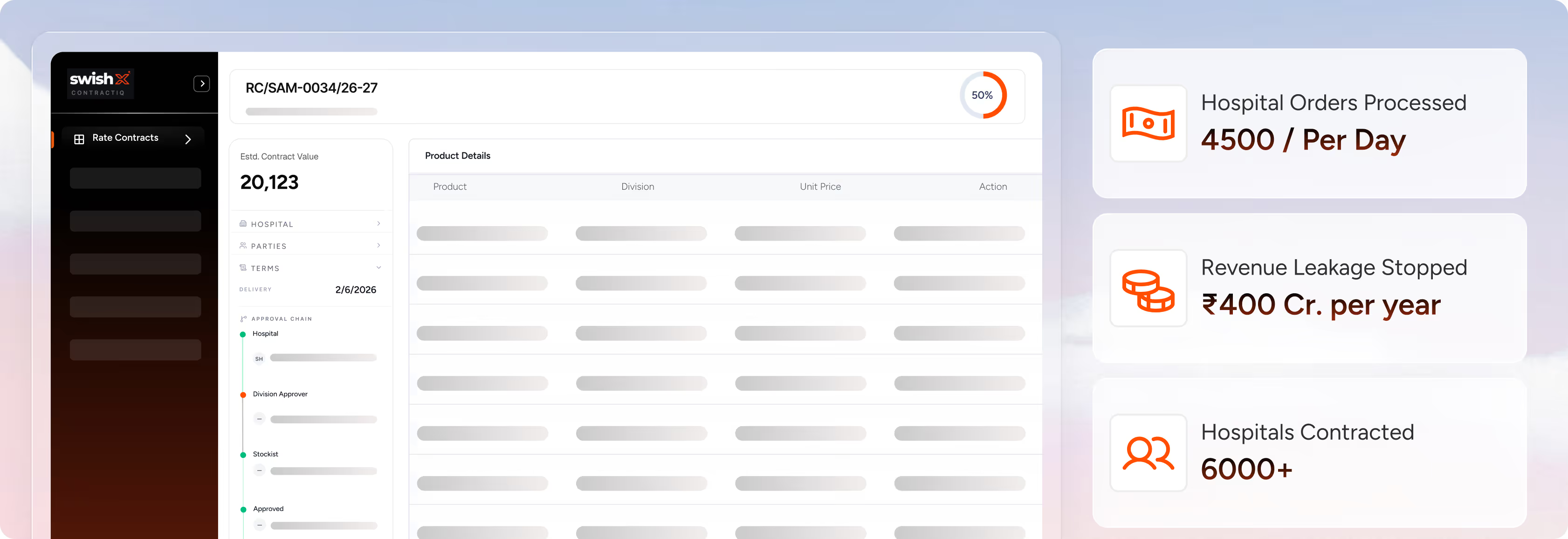
Hospital and institutional tender management also changes. Rate contracts negotiated with hospitals often have compliance problems when you cannot verify that supplies are happening at the contracted price and quantity. Secondary visibility into institutional channels gives the CFO real leverage in managing price compliance and prevents the revenue leakage that happens when rate contracts are loosely monitored.
Incentive design for the field force gets sharper when it is anchored to secondary outcomes. Right now, most field incentive plans in Indian pharma reward behaviors that proxy for market outcomes: calls made, stockist visits, primary orders generated. When you can tie incentives directly to retail offtake, scheme reach, or active retailer count in a territory, the alignment between what you are paying for and what you actually need improves significantly.
What a Company with Real Secondary Visibility Looks Like
A pharma company with genuine secondary visibility runs its monthly commercial review with data that shows actual sell-out at the stockist level, not just sell-in. The regional sales manager can see which stockists in her territory have healthy offtake and which are building inventory. She can see which retailers have not placed an order in the last 45 days. She knows which SKUs are moving well in the north but are slow in the east, and can see whether that correlates with scheme awareness, field rep activity, or something else entirely.
The CFO has a view on channel inventory aging that lets him flag near-expiry risk before it becomes a P&L problem. He can see the gap between primary and secondary sales across regions and understand what it means for the quality of the revenue being booked.
The trade marketing team can see scheme utilization at the retailer level. They know whether the scheme reached the intended retailer segment or whether it was absorbed by larger stockists. This changes how they design and target the next one.
The CEO has a single dashboard that gives her an honest picture of what is happening in the market, not just what shipped out of the warehouse. When she asks why growth in Karnataka is outpacing Maharashtra, she gets an answer grounded in actual transaction data from the channel, not a field team's best guess.
This is not a fantasy scenario. It is operationally achievable for any pharma company with a serious channel network if the right data infrastructure is in place.
The Real Unlock Is in the Commercial Layer, Not Just Reporting
Secondary visibility is often framed as a reporting upgrade. Better dashboards. More granular MIS. That framing undersells what it actually enables.
The real unlock is in the commercial actions that become possible when you have the data. You can run smarter schemes because you know who to target and can verify reach. You can deploy your field force against the right priorities because you can see where the actual gaps and opportunities are. You can stop channel loading behaviors because you are measuring what matters on the sell-out side. You can reduce expiry losses systematically because you have the forward-looking signals to act on.
The Indian pharma market is not going to get simpler. Regulatory requirements around traceability are increasing. Competition for shelf space and doctor mindshare is intensifying. The companies that will build durable commercial advantage over the next decade are the ones that figure out how to operate the downstream network with the same rigor they bring to manufacturing and regulatory compliance.
Secondary sales visibility is where that rigor starts. It is not a feature. It is the foundation.
About Author:
Dushyant Sapre is the Founder and CEO of SwishX, an AI-native commercial excellence platform for pharma. SwishX works with pharma manufacturers across India to deploy digital workflows across sales, marketing, and channel operations with outcomes tracked at the metric level.




.avif)


.png)
%20(1).avif)




.svg.avif)