How AI is Transforming HCP Engagement in Pharma Marketing in 2026
Gourab Paul
May 21, 2026
Walk into any pharma brand review in India right now and you will hear the same frustration. Doctors are harder to reach. MR face time is shrinking. Digital engagement metrics look busy but conversion to prescription behaviour is unclear. The tools that worked five years ago are producing diminishing returns, and the teams running them know it.
What is actually happening is not a temporary dip. It is a structural shift in how healthcare professionals consume information, make prescribing decisions, and expect to be engaged by pharma brands. And the companies that are recalibrating now, rather than waiting for the next annual planning cycle, are building engagement advantages that will be very difficult for slower movers to close.
Artificial intelligence sits at the centre of this recalibration. Not as a technology experiment, but as the operational layer that makes personalised, compliant, scalable HCP engagement possible for the first time.
Why Traditional HCP Engagement Is Breaking Down
The traditional HCP engagement model in Indian pharma was built around the medical representative. The MR called on doctors, left samples and literature, built relationships over time, and reported activity back to the commercial team. At its best, this model worked because it was human, local, and relationship-driven. At its worst, it was expensive, inconsistent, and almost impossible to measure meaningfully.
The cracks in this model have been widening for years. Doctor availability for MR visits has been declining steadily. Post-COVID, many hospital systems tightened visitor policies and they have not fully relaxed them. The average productive time a doctor spends with an MR, in markets where access still exists, has compressed to under two minutes in many specialties. Digital-native younger doctors increasingly prefer to find information on their own terms, through channels they control, at times that suit them.
Meanwhile, the compliance environment has tightened. UCPMP guidelines and the CDSCO framework have raised the bar on what pharma companies can say, show, and claim in promotional materials. The cost of a compliance misstep, in both regulatory and reputational terms, has gone up. This makes mass, undifferentiated outreach increasingly risky on top of being increasingly ineffective.
The result is a gap between where pharma brands need to be and where their current engagement capabilities can take them. Filling that gap requires a different approach, and AI is what makes that approach operationally viable.
What AI-Driven HCP Engagement Actually Looks Like
AI-driven HCP engagement is not about replacing human relationships. It is about making every interaction more relevant, better timed, and more likely to land. The practical manifestations of this are worth being specific about because the term AI gets attached to a wide range of capabilities, some genuinely transformative and some essentially cosmetic.
The first meaningful application is personalisation at scale. A pharma brand with a portfolio spanning five therapy areas and a doctor universe of 200,000 HCPs cannot meaningfully personalise outreach manually. AI changes this by building individual engagement profiles for each doctor, drawing on specialty, prescribing history where accessible, past content engagement, channel preferences, and regional context. The result is that a cardiologist in Pune receives different content, at a different cadence, through a different channel mix, than a diabetologist in Coimbatore. Not because someone manually configured it, but because the AI model learned what engagement pattern drives response for each profile type.
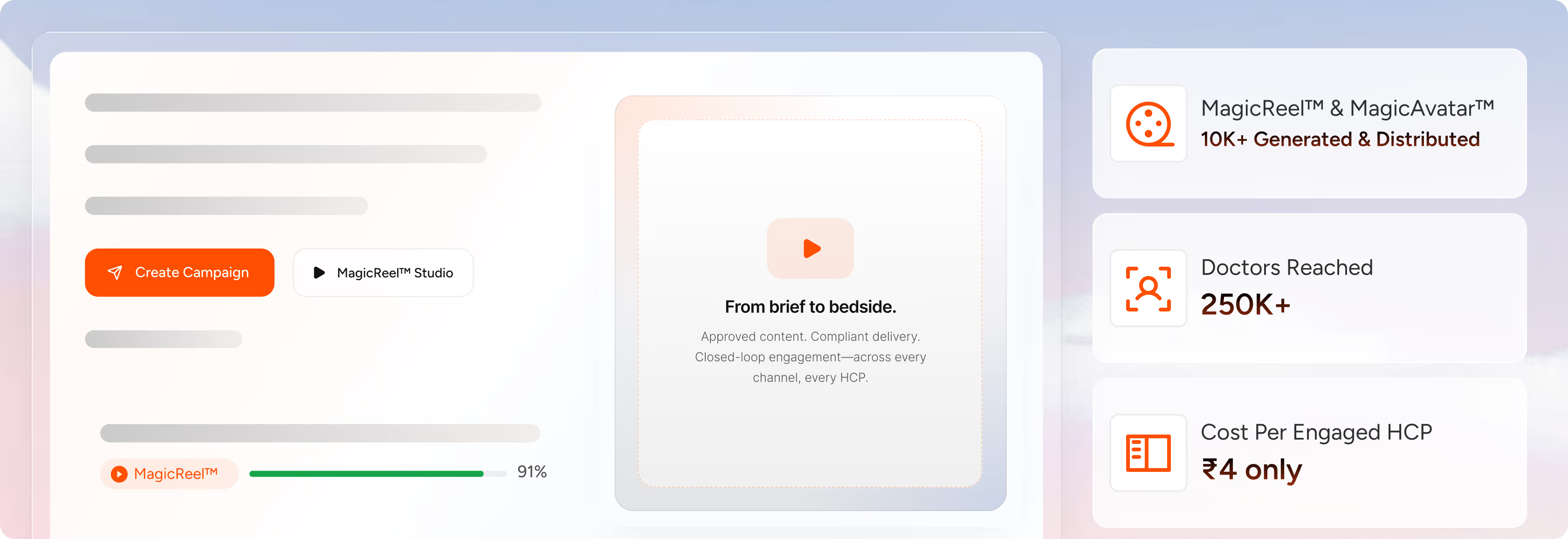
The second application is content intelligence. AI systems can analyse which content formats, topics, and claims resonate with specific HCP segments, and can generate or adapt content accordingly. This includes the kind of video content that has become the dominant format for HCP education globally. SwishX's Marketing IQ platform includes MagicReel, which converts product monographs and clinical data into 60 to 120 second branded video reels tailored by specialty and channel, without requiring agency production timelines or budgets.
The third application is channel orchestration. AI determines not just what to send but when and through which channel. WhatsApp, email, SMS, and rep-assisted channels each have different response rates for different HCP segments at different points in the engagement lifecycle. An AI orchestration layer optimises across these channels in real time based on observed engagement behaviour, rather than applying a fixed sequence to everyone.
The Compliance Layer Nobody Can Afford to Ignore
In pharma marketing, personalisation without compliance is not a feature. It is a liability. This is the dimension that separates genuinely built-for-pharma AI tools from general marketing automation platforms that have been retrofitted with pharma language.
UCPMP compliance in India requires that all promotional communications to HCPs stay within approved claims, do not reference unapproved indications, include mandatory safety information where required, and are directed only at qualified healthcare professionals. These requirements apply to every piece of content, every channel, and every interaction. The compliance review process for traditional content production is one of the biggest bottlenecks in pharma marketing, often adding two to four weeks to content deployment cycles.
AI changes this in two ways. First, by building compliance guardrails into the content generation process itself, so that outputs are pre-screened against UCPMP parameters before they are ever reviewed by a human. Second, by maintaining an audit trail of every piece of content sent to every HCP, which makes regulatory review and internal compliance reporting dramatically simpler. Teams using AI-assisted content tools with built-in compliance frameworks are not just moving faster. They are moving with lower risk.
Measuring HCP Engagement That Actually Means Something
One of the persistent frustrations in pharma marketing is the measurement problem. Open rates, video views, click-throughs: these are engagement proxies. They tell you something was seen. They do not tell you whether it changed prescribing behaviour, which is the only metric that ultimately matters for a brand team.
AI-driven engagement platforms are closing this gap by connecting engagement data to downstream outcomes more directly. When a doctor who received a specific video sequence about a cardiac molecule shows a measurable uptick in prescribing that molecule in the following quarter, and that pattern holds across a statistically significant cohort, you have moved from engagement metrics to engagement evidence. This is the measurement standard that brand managers and medical affairs teams are increasingly being asked to meet, and it is only achievable with the kind of connected data infrastructure that AI platforms provide.
For brand managers looking for a practical picture of what closed-loop HCP engagement measurement looks like, read our piece on measuring what your field force actually moves versus what it just reports.
Where Indian Pharma Stands Right Now
The adoption curve for AI-driven HCP engagement in Indian pharma is steep but still early. The largest companies have been running pilots for two to three years and are now moving to scaled deployment. Mid-size companies are at the evaluation stage, with many having conducted proofs of concept in one or two therapy areas. Smaller companies are largely watching, constrained by budget assumptions about AI tools that are increasingly outdated.
The competitive dynamic this creates is worth paying attention to. Early adopters are accumulating something that late entrants cannot easily replicate: data. Every engagement cycle generates more information about what works for which HCP segment in which therapy area. The AI models running on that data get progressively better. A company that has been running AI-driven HCP engagement for two years has a model that is materially smarter than one that started six months ago, and the gap widens with every cycle.
This is not a reason to rush into any platform without due diligence. It is a reason not to treat AI-driven HCP engagement as something to evaluate next year. The compounding advantage accrues to whoever starts building it first.
The Practical Starting Point
For pharma brand managers evaluating where to start, the most tractable entry point is usually content personalisation for a single high-priority therapy area. Pick the molecule or portfolio segment where HCP engagement is most critical to commercial performance. Map the key HCP segments within that therapy area. Identify the content gaps in your current programme. Then ask what an AI-assisted engagement platform would do differently for that specific use case.
The answer to that question, done honestly with a platform that actually knows pharma rather than one that has bolted pharma language onto general marketing automation, will tell you more about the ROI case than any vendor presentation.
AI-driven HCP engagement uses machine learning to personalise content, optimise channel selection, and time outreach to individual healthcare professionals based on their specialty, behaviour, and engagement history, at a scale that manual processes cannot match.
AI tools built for pharma embed UCPMP compliance guardrails into the content generation process, pre-screening outputs against approved claims and regulatory parameters before human review. This reduces compliance cycle time and lowers the risk of non-compliant content reaching HCPs.
Yes. The cost of AI-powered engagement platforms has come down significantly, and the ROI case is often stronger for mid-size companies because the efficiency gains relative to existing manual processes are larger. Starting with one therapy area is a practical entry point.
Beyond open and click-through rates, the metrics that matter are video completion rates by HCP segment, re-engagement frequency, and ultimately the correlation between engagement patterns and prescribing behaviour change. AI platforms that connect engagement data to downstream outcomes provide the most actionable measurement framework.



.avif)


.avif)





.svg.avif)