Medical Representative Productivity in 2026: How AI Tools Are Changing Field Force Ops
Jai Anand
May 21, 2026
Ask any pharma sales head in India what their field force productivity problem is and they will tell you the same thing: MRs are covering beats, filing reports, and logging calls, but the commercial output per rep is not moving in proportion to the activity. More calls, more coverage, similar results. The ratio feels wrong and nobody has a clean explanation for why.
The explanation is usually not motivation or effort. It is work composition. The average pharma MR in India spends a significant portion of their working week on activities that have nothing to do with the conversation that drives prescription behaviour: travel time between calls, administrative reporting, waiting room time, document handling, and navigating internal approval processes for materials and samples. When you strip all of that away and look at the actual time spent in productive clinical conversation with a doctor, the number is surprisingly small.
AI tools designed specifically for field force operations are changing this. Not by replacing MRs, but by eliminating the administrative and logistical overhead that currently consumes most of their productive capacity.
What MR Time Actually Looks Like in 2026
It is worth being specific about where the time goes, because the problem is easier to dismiss at the aggregate level than when you look at the breakdown honestly.
The average pharma MR in India conducts somewhere between 8 and 12 doctor calls per working day, depending on the territory, specialty mix, and urban versus semi-urban geography. Each call involves travel to the facility, waiting time in the reception or OPD, the actual interaction with the doctor (typically 90 seconds to three minutes), and the post-call documentation. The ratio of productive clinical conversation to total time invested in the call is often below 20 percent.
Add to this the time spent on daily beat planning, which in most companies is still done manually against a paper or spreadsheet roster. Add the time spent preparing for calls by reviewing detailing materials, which are often not well-organised or quickly accessible on the MR's device. Add the time spent on expense reporting, sample management documentation, and internal reporting to the area manager. The administrative overhead is not small. It is often the largest single category of how MR time gets consumed.
AI tools address this not by making MRs work harder but by automating the tasks that should not require a skilled MR's time in the first place.
Beat Planning and Call Prioritisation
The first area where AI materially changes MR productivity is beat planning and call prioritisation. Traditional beat planning allocates MR time against a fixed doctor roster, typically organised by geography and updated quarterly. It does not reflect real-time information about which doctors are most commercially important to visit this week, which are due for follow-up based on previous engagement, or which have shown recent signals of interest through digital engagement with content.
AI-powered call planning systems change this by generating dynamic call priority lists that incorporate multiple signals: prescription data where accessible, digital content engagement patterns, sample request history, competitive activity intelligence, and time since last productive call. The result is that the MR's call list for any given day reflects actual commercial priority rather than geographic proximity.
The downstream impact on productivity is significant. MRs who are visiting the right doctors at the right frequency, informed by data rather than habit, convert their calls at materially higher rates than MRs working against a static beat plan that was last reviewed three months ago.
Pre-Call Preparation and Content Delivery
The second area of AI impact is pre-call preparation. Most MRs currently prepare for calls by reviewing whatever materials are on their tablet or phone, which are often a mix of approved current content, outdated older content that was never cleared off the device, and informal WhatsApp material shared by the team. The quality and relevance of pre-call preparation is inconsistent, and the time it takes cuts into field time.
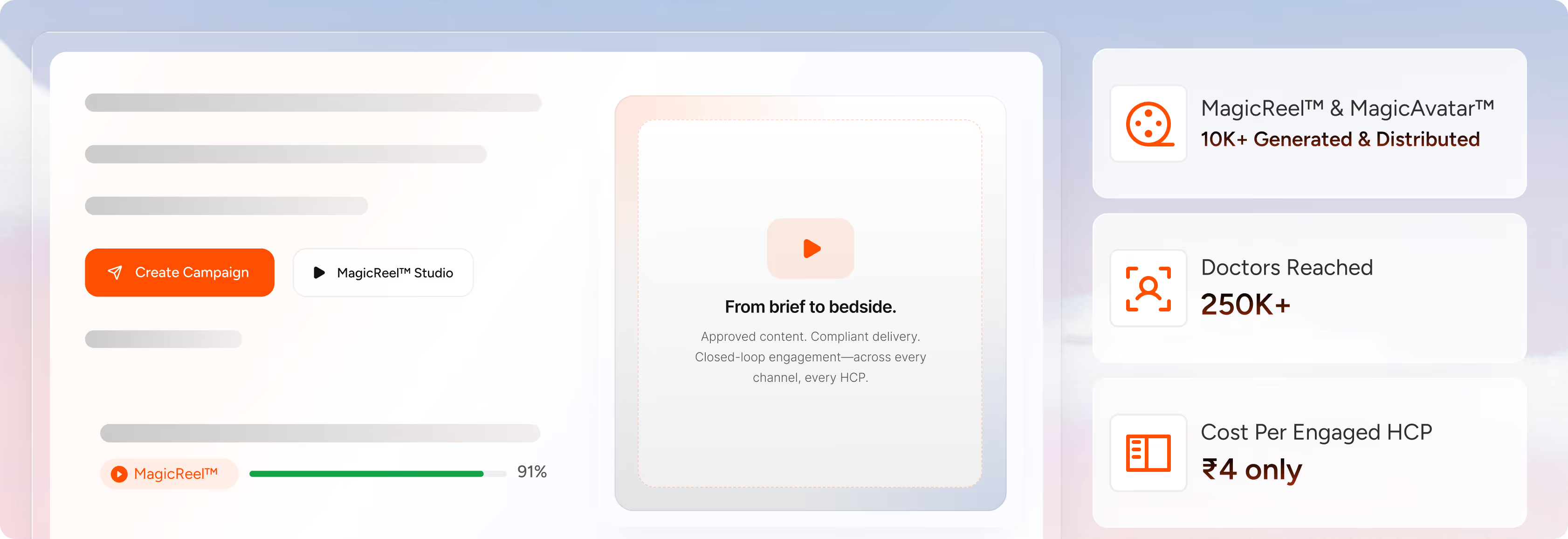
AI tools integrated with platforms like SwishX's Marketing IQ change this by surfacing the most relevant, approved content for each upcoming call based on the doctor's profile, specialty, and recent engagement history. Before calling on a cardiologist who recently watched a MagicReel on a particular molecule, the MR's pre-call brief highlights that specific engagement and suggests the most productive angle for the conversation. Before calling on a GP who has not been engaged recently, it suggests the re-engagement approach most likely to land.
This is not just time saving. It is call quality improvement. MRs who show up to calls with specific, relevant, current information perform better than MRs who show up with generic detailing materials and a standard pitch.
Post-Call Reporting and Documentation
Post-call reporting is one of the most consistently cited sources of MR time waste. The average MR spends 20 to 40 minutes per day on call documentation, expense logging, and reporting to managers. For a field team of 100 MRs, that is 2,000 to 4,000 person-hours per week going into administrative tasks rather than customer-facing activity.
AI-assisted reporting tools reduce this significantly by auto-populating call records from structured inputs (doctor name, call duration, content shown, sample given) and using voice-to-text for qualitative notes. Some platforms are moving toward automatic call logging based on GPS and calendar data, requiring the MR only to confirm and annotate rather than build the record from scratch.
The compliance benefit of better-structured call documentation is also worth noting. Regulatory and internal audit processes that require evidence of call activity are served by more complete, consistent records than manual MR reporting typically produces.
Digital Engagement as a Field Force Force Multiplier
The relationship between digital HCP engagement and field force productivity is one that most pharma companies have not fully worked out yet, but the direction is clear. MRs who call on doctors who have already engaged with relevant digital content perform better than MRs going in cold. The digital touchpoint does part of the awareness and education work before the MR arrives, which means the clinical conversation can start at a higher level and cover more productive ground in the same time window.
This creates a coordination requirement between the digital engagement programme and the field force. MRs need to know which of their doctors have engaged with which content so they can reference it appropriately in the call. The engagement data needs to flow from the marketing platform to the MR's call planning tool. In most pharma companies today, this data handoff is not happening systematically. The digital and field teams are running parallel programmes with limited integration.
AI-powered field force tools that connect to the digital engagement layer solve this by making HCP digital engagement history a visible, actionable input to the MR's daily work. The MR does not need to check a separate system. The information surfaces in their normal call planning interface as part of the prioritisation logic.
For the broader picture of how field force activity connects to measurable commercial outcomes, our piece on activity versus impact covers the measurement framework in detail.
What the Productivity Numbers Look Like
Pharma companies that have implemented AI-assisted field force tools consistently report the same categories of improvement. Call productivity per MR increases, typically in the range of 15 to 25 percent, driven by better prioritisation and reduced administrative overhead. Doctor engagement quality improves, as measured by conversation depth, sample acceptance, and follow-up request rates. Content compliance improves, as MRs are using only current, approved materials surfaced by the platform rather than whatever they have accumulated on their devices.
The aggregate effect on commercial performance is difficult to isolate from other variables, but the direction is consistent across the companies that have done this well. Field force productivity is not primarily a hiring or training problem. It is a tools and data problem. And the tools to address it are now available and proven.
The primary driver is work composition rather than effort level. MRs spend a disproportionate share of their time on administrative tasks, travel, and waiting time, leaving a small fraction for productive clinical conversation. AI tools address this by automating the administrative layer and improving the quality of preparation for the time that is spent in front of doctors.
AI beat planning systems generate dynamic call priority lists that incorporate prescription data, digital engagement signals, sample history, and time since last productive call. This replaces static geographic rosters that do not reflect real-time commercial priority. MRs working against AI-generated call plans convert calls at higher rates than those working against fixed quarterly beat plans.
The average pharma MR in India spends 20 to 40 minutes per working day on call documentation, expense logging, and manager reporting. For a field team of 100 MRs, this represents 2,000 to 4,000 person-hours per week in administrative overhead. AI-assisted reporting tools reduce this to a fraction of current levels through auto-population and voice-to-text inputs.
No, and the most effective implementations of AI field force tools are designed with this premise. AI tools eliminate administrative overhead and improve call quality by surfacing better information before and during calls. The relationship and clinical conversation competency of a skilled MR is not replicated by AI. The goal is to concentrate more of the MR's time on the work that only they can do.




.avif)


.avif)





.svg.avif)