Pharma Contract Management in 2026: Why Excel and Email Are Costing You Millions
Dushyant Sapre
May 26, 2026
There is a conversation that happens in pharma company finance meetings at least once a quarter. Someone flags a contract that was supposed to be renewed six months ago. Someone else notes that a hospital account they won last year has been ordering at a different rate than what the contract specifies. A third person mentions that the legal team is still reviewing a co-marketing agreement that was sent for approval in February. The finance head asks how many other contracts are in this state. Nobody knows precisely.
This is not a people problem. The legal, finance, and supply chain teams are not negligent. They are managing contract portfolios of significant complexity using tools, primarily Excel and email, that were not designed for the volume, interconnection, and compliance requirements of modern pharma contract management.
The cost of this gap is real, measurable, and in most cases, underestimated.
The Real Cost of Excel and Email in Pharma Contract Management
The costs of inadequate contract management infrastructure fall into four categories that are worth separating because they each require different fixes.
The first is missed renewal revenue. A rate contract with a hospital or institutional buyer that lapses because nobody tracked the renewal date does not just pause the revenue from that account. In many cases, it ends it. Hospitals that have been negotiating direct supply relationships with multiple pharma companies will accept the first renewal proposal they receive at acceptable terms. A company that is two weeks late because the renewal date was buried in a spreadsheet tab that nobody checked may find that the account has moved to a competitor who had their renewal process automated.
Contract IQ's product page puts this reality plainly: hospitals are demanding direct rate contracts in 24 hours as the new normal. The companies that can respond at that speed are winning accounts that slower-moving competitors are losing permanently.
The second cost is price leakage. When actual supply prices drift from contracted rates, the margin loss is invisible until the reconciliation audit. By the time the discrepancy surfaces, weeks or months of margin has already gone. At the transaction volumes of a mid-size to large pharma company, even a 1 to 2 percent price drift across an institutional supply portfolio represents crores of margin erosion per year.
The third cost is compliance exposure. Pharma contracts, whether hospital rate contracts, co-marketing agreements, licensing deals, or supply agreements, carry regulatory and legal obligations that must be tracked and fulfilled. A contract that required a compliance submission by a certain date and did not get it because nobody was tracking the obligation creates exposure that can range from a contractual breach to a regulatory violation depending on the contract type.
The fourth cost is management bandwidth. The hours that legal, finance, and commercial teams spend manually tracking contract status, chasing signatures, reconciling terms against invoices, and building reports for CXO review is not small. In pharma companies managing hundreds of institutional contracts plus licensing, co-marketing, and supply agreements, the administrative overhead of Excel-based contract management is a material cost on the P&L that rarely gets measured as such.
What AI-Powered Contract Management Actually Fixes
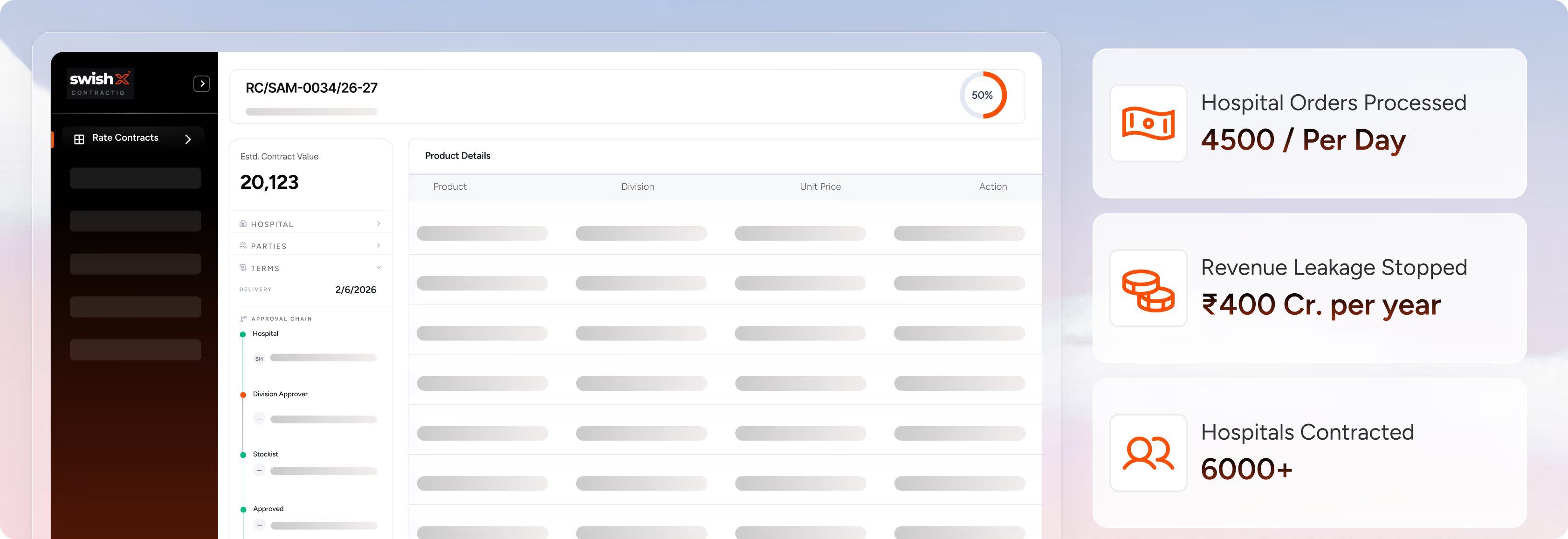
SwishX's Contract IQ is built specifically for pharma institutional supply contracts, which is an important distinction from generic contract lifecycle management platforms. The core problems it addresses are the four cost categories described above, through five capabilities that work together.
The first is contract generation speed. Contract IQ can generate a complete, legally structured rate contract from a hospital RFQ in hours, not days. Built-in version control and parallel CXO sign-off routing replace the sequential email chain that traditionally adds days to the drafting and approval process. The product claims a 24-hour turnaround from RFQ to executed rate contract, against an industry average of two to three weeks. For hospital accounts where responsiveness is now a selection criterion, this speed difference is commercially decisive.
The second is post-contract supply chain activation. The moment a contract is signed, Contract IQ activates the supply chain automatically. Stockist coordination, delivery scheduling, and order confirmations run without manual intervention. This closes the gap between contract execution and first delivery, which is where SLA breaches and early relationship damage typically occur.
The third is real-time price enforcement. Price enforcement happens at the transaction level, not at the month-end audit. When actual supply prices diverge from contracted rates, even on a single order, an alert fires immediately. Margin is protected at the point of action rather than recovered after the fact.
The fourth is hospital account analytics. Which accounts are performing against their contracted value? Which are under-delivering and creating expiry risk from over-supply? Which are over-performing and creating inventory strain? These questions have answers in Contract IQ that are not available in Excel-based contract tracking without significant manual effort.
The fifth is compliance governance. UCPMP and 194R compliance are enforced before every action, not reviewed at output. The audit trail is automatic and audit-ready without manual documentation effort.
Why the Status Quo Is Increasingly Untenable
Two market shifts are making the Excel and email approach to pharma contract management progressively more costly to maintain.
The first is the trend toward hospital in-housing of pharmacies and direct supply relationships. Hospitals that previously procured through distributor networks are increasingly building direct relationships with pharma manufacturers. This creates contract volumes that are significantly higher than most pharma companies' legal and commercial teams were staffed to manage manually. A company that managed 20 hospital rate contracts five years ago may now be managing 200 and heading toward 2,000.
The second is the increasing contractualisation of pharma commercial relationships. Co-marketing agreements, co-promotion deals, licensing arrangements for in-licensed molecules, supply agreements for toll manufacturing, and distributor agreements with performance clauses are all becoming more common and more complex. Each adds to the contract portfolio that needs to be tracked, renewed, and enforced.
The teams managing these portfolios with Excel and email are not failing because of effort or competence. They are failing because the tools are structurally unable to keep up with the volume and complexity of what they are being asked to manage.
The Business Case in Numbers
For a pharma company with 150 active institutional contracts and an average contract value of Rs 50 lakhs per year, the annual contract portfolio value is Rs 75 crore. If even 5 percent of that value is lost annually to missed renewals, price leakage, and compliance failures combined, that is Rs 3.75 crore of avoidable loss.
Across 300 contracts at the same average value, the pool is Rs 7.5 crore annually. For larger companies with higher contract values and more complex portfolios, the number is materially higher.
Against this, the cost of contract management software is a rounding error. The business case is not complex. The question is not whether better contract management creates commercial value. It is whether the organisation is ready to instrument the change.
For context on how hospital rate contract speed specifically connects to institutional business growth, read our detailed piece on contract renewal management in pharma.
Pharma contract management software provides automated renewal tracking with alerts before lapse dates, real-time price enforcement at the transaction level rather than at month-end audit, parallel approval routing that replaces sequential email chains, post-contract supply chain activation without manual intervention, and an audit-ready compliance trail. Excel cannot do any of these automatically and requires significant manual maintenance to approximate even basic contract tracking.
Price leakage in pharma institutional contracts, where actual supply prices drift from contracted rates between audit cycles, typically runs at 1 to 3 percent of contracted value per year when not actively monitored. For a company managing Rs 75 to 150 crore in institutional contract value, this represents Rs 75 lakhs to Rs 4.5 crore in annual margin erosion that is not visible until reconciliation audits.
Hospitals are increasingly demanding rate contract responses within 24 to 48 hours. The industry average for drafting, approving, and executing a rate contract through traditional workflows is two to three weeks. Companies that cannot close this speed gap are losing hospital accounts to competitors who can, particularly as hospitals build direct supply relationships and have multiple pharma suppliers competing for their business.
The biggest risks are missed renewal dates that cause account lapse, undetected price leakage between audit cycles, compliance obligation failures because nobody was tracking the deadline, and the management bandwidth consumed by manual contract tracking that could be deployed on commercial activity. All four are addressed by contract management platforms designed for pharma institutional supply.




.avif)







.svg.avif)