The ROI of AI in Pharma Marketing: What the Numbers Actually Say
Jai Anand
May 21, 2026
The ROI question for AI in pharma marketing gets asked in every budget conversation, and it deserves a more honest answer than the vendor-supplied case studies typically provide. Not because the ROI is not real, but because how you measure it determines whether you are actually capturing the value or just generating numbers that look good in a presentation.
There are three distinct ROI streams from AI-powered pharma marketing. They operate on different timescales. They are measured differently. And conflating them, or measuring only the easiest one, produces an incomplete picture that leads to either overselling the investment or underinvesting in it.
This piece separates the three streams, shows how to measure each honestly, and explains why the numbers compound in ways that the first-year ROI calculation does not capture.
ROI Stream 1: Cost Reduction in Content Production
The most immediately measurable ROI from AI pharma marketing tools is the reduction in content production cost. This is the easiest to quantify and the one most vendor presentations lead with, which is partly why it tends to be treated as the whole story rather than one chapter of it.
The baseline for comparison is traditional pharma content production: agency briefs, storyboarding, filming or animation, voiceover, medical-legal review cycles, revisions, and final approval. For a 60 to 90 second promotional video, this process typically runs between Rs 3 lakh and Rs 12 lakh per asset depending on production quality and the number of revision cycles. For a complex e-detailing module, costs can be significantly higher. Add agency fees for EDM design, leave-behind production, and microsite development, and a mid-size pharma brand team managing five to eight molecules can easily be spending Rs 2 to 4 crore annually on content production alone.
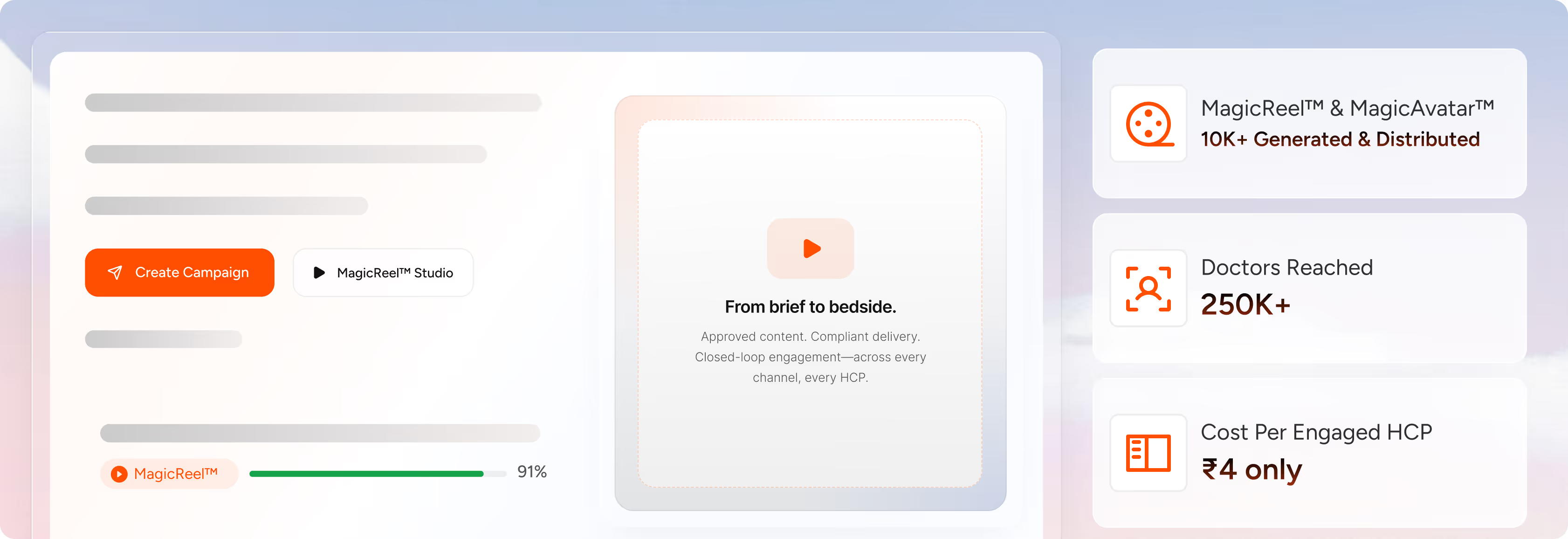
AI content generation changes the cost structure fundamentally. A MagicReel video generated from an approved product monograph through SwishX's Marketing IQ platform costs a fraction of traditional production. The content generation step that previously consumed weeks and lakhs now takes minutes and thousands of rupees. For a brand team producing 50 to 80 content assets per year, the direct cost saving is substantial and straightforward to calculate.
But the cost saving is not just in the per-asset production cost. It is also in the overhead of managing the production process: briefing cycles, agency coordination, revision management, approval routing. These are invisible costs that do not appear on an agency invoice but consume significant brand team and medical affairs bandwidth. AI tools that integrate content generation with approval workflows eliminate most of this overhead, freeing team time for higher-value strategic work.
ROI Stream 2: Revenue from Improved Engagement Conversion
The second ROI stream is harder to measure but larger in commercial impact. It is the revenue uplift from higher HCP engagement conversion rates: more doctors receiving relevant content, more doctors engaging with that content, more engagement converting to prescription conversations, more prescription conversations converting to prescribing behaviour change.
The causal chain from AI-powered personalised engagement to incremental prescribing is real but involves multiple steps, which is why many pharma marketing teams either do not measure it systematically or measure it imprecisely and undercount the impact.
The right measurement framework starts with engagement quality rather than engagement volume. An HCP who watches a mechanism of action reel to completion, replays a segment, and then requests the clinical study from the MR is a qualitatively different engagement signal than an HCP who opened an email and closed it. AI platforms that track these qualitative engagement signals, as opposed to just open rates and send volumes, give you a much better leading indicator of conversion.
From there, the measurement requires connecting engagement data to prescription data over a sufficient time horizon. The typical lag between an HCP engagement programme launching and a measurable change in prescribing patterns is two to four months, which means quarterly ROI reviews will consistently undercount the impact. Companies that have built honest measurement frameworks for this ROI stream consistently report engagement-to-conversion improvements in the range of 15 to 35 percent when they move from generic multichannel outreach to genuinely personalised AI-driven engagement.
ROI Stream 3: The Compounding Data Advantage
The third ROI stream is the hardest to quantify in year one but becomes the most significant over time. It is the compounding value of the HCP engagement data that an AI-powered marketing programme generates and learns from with every cycle.
Every campaign, every content deployment, every HCP interaction generates data about what works for which doctor profile in which therapy area in which geography at which stage of the prescribing journey. An AI system that learns from this data gets progressively better at predicting engagement and optimising content and channel choices. The ROI from year three of a well-run AI engagement programme is materially higher than year one, not because the programme has scaled but because the underlying model is smarter.
This compounding advantage is not available to companies that are not running AI-driven engagement programmes. You cannot buy two years of accumulated HCP engagement intelligence. You can only earn it through deployment. This is why the real ROI question for AI in pharma marketing is not what does it return in year one. It is what is the cost of not starting in year one when your competitors already have.
What the Numbers Actually Look Like
For a mid-size pharma company spending Rs 3 crore annually on marketing content production and HCP engagement activities across five therapy areas, a conservative estimate of the combined three-stream ROI from AI-powered marketing tools looks roughly like this.
Content production cost reduction of 40 to 60 percent on the content budget represents Rs 1.2 to 1.8 crore in annual savings. Engagement conversion improvement of 20 percent across an HCP universe that generates Rs 15 crore in directly attributable prescription revenue represents Rs 3 crore in incremental revenue. These two streams alone, in year one, deliver a return that is multiples of the platform investment. The compounding data advantage starts paying dividends from year two onwards and is difficult to put a clean number on, but it is the stream that makes market leaders out of early adopters over a three to five year horizon.
The honest caveat is that these numbers require measurement discipline to capture. Companies that do not build the attribution framework to track engagement-to-prescription conversion will consistently undercount the revenue impact and make AI investment decisions based on the cost saving alone, which is real but not the whole picture.
AI pharma marketing ROI has three distinct streams: direct cost savings from reduced content production costs, revenue uplift from improved HCP engagement conversion rates, and the compounding value of accumulated HCP engagement data. Each requires a different measurement framework. The most common error is measuring only the first stream, which is the smallest of the three over a three to five year horizon.
Cost savings are visible from month one. Engagement conversion improvements typically show in two to four months as HCP engagement patterns shift. Downstream prescribing behaviour change follows the engagement improvement by another two to four months. The full three-stream ROI picture requires at least a six to nine month measurement window, and the compounding data advantage compounds over years not months.
For pharma companies using traditional agency production workflows, AI content generation tools typically deliver 40 to 60 percent reductions in per-asset production cost, with additional savings from reduced agency coordination overhead and faster approval cycles. The absolute saving depends on current production volume and per-asset spend, but for teams producing 50 or more content assets per year, the savings are substantial.
AI improves HCP engagement conversion by personalising content to each doctor's specialty and engagement history, optimising channel selection and timing based on observed engagement behaviour, and enabling re-engagement of dormant HCPs with content calibrated to their last known interest. The aggregate effect on conversion rates from generic to personalised AI-driven engagement is typically in the range of 15 to 35 percent across the HCP universe.



.avif)







.svg.avif)