Personalized HCP Outreach at Scale: A Practical Guide for Pharma Brand Managers
Jai Anand
May 22, 2026
The phrase personalised HCP outreach has been in pharma marketing vocabulary for years. It has also, for most of those years, described something that was personalised only in the loosest sense. The doctor's name in the email subject line. A therapy area filter on the distribution list. Regional language on the brochure cover. These are not personalisation. They are segmentation with a personalisation label on top.
True personalisation, the kind that actually changes how a doctor engages with a brand, requires understanding that specific individual's clinical context, communication preferences, prescribing patterns, and information needs, and then shaping every interaction accordingly. Until recently, doing this at the scale of a 50,000 HCP target universe was not operationally feasible. AI has changed that.
This piece is a practical guide for pharma brand managers who want to understand what personalised HCP outreach at scale actually requires, what the building blocks are, and where to start.
Why Generic Outreach Is Getting More Expensive to Use
The problem with undifferentiated HCP outreach is not just that it underperforms. It is that its cost is rising while its returns are declining, which makes the economics increasingly difficult to defend.
Regulatory scrutiny on pharma promotional communications has intensified. Every piece of content sent to an HCP carries compliance exposure. The more you send, the more exposure you carry. Blanket campaigns to broad HCP lists, which made sense when the marginal cost of reaching an additional doctor was near zero and compliance risk was lower, are becoming harder to justify when both factors have moved against you.
Doctor fatigue with undifferentiated pharma communications is also real and well-documented. HCPs who receive irrelevant content stop engaging, and once engagement drops, it is very difficult to recover. An HCP who has mentally filed your brand's communications as noise will not suddenly start paying attention when you send something genuinely relevant. The unsubscribe rates and open rate declines that pharma marketing teams have been watching for several years are partly a consequence of too much generic communication eroding the attention budget that relevant communication needs.
Personalisation at scale is not just a better marketing approach. It is increasingly the only economically defensible one.
The Four Building Blocks of Personalised HCP Outreach
Personalisation at scale requires four things working together. Most pharma companies have some version of each individually. Very few have all four integrated in a way that enables genuine personalisation rather than better-labelled segmentation.
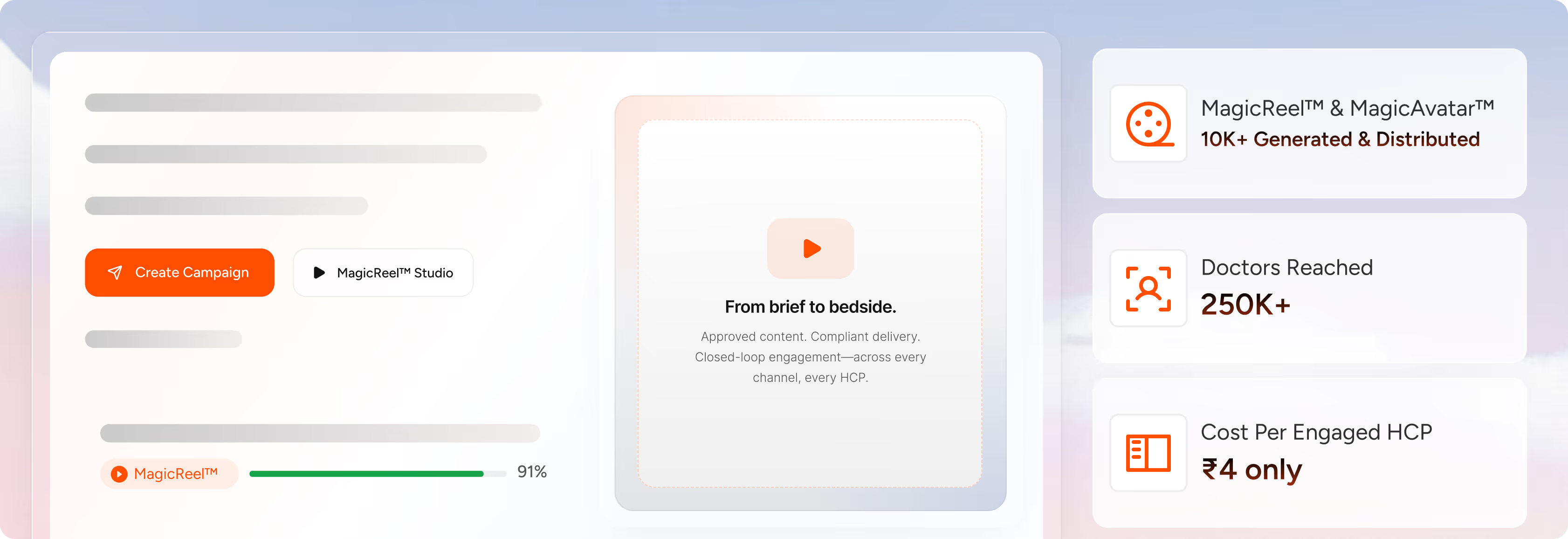
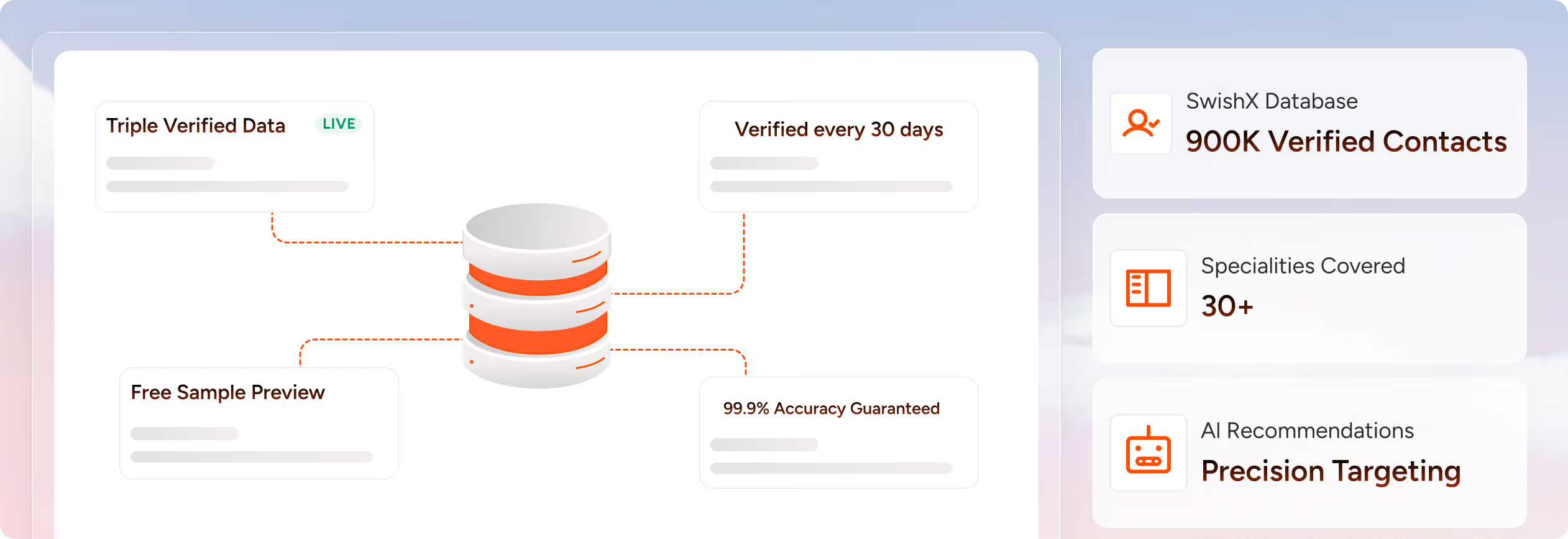
The first building block is a verified, enriched HCP data foundation. Personalisation requires knowing who you are talking to, not just their name and specialty. Verified HCP profiles that include specialty, sub-specialty where relevant, geography, hospital affiliation, practice setting, preferred communication channels, and historical engagement behaviour are the raw material without which no personalisation system can function. Platforms like SwishX's Marketing IQ maintain a verified database of over 1,00,000 HCP profiles across 284 cities and 26 therapy areas, which provides the data foundation that personalised outreach requires.
The second building block is content that can actually be personalised. Generic brand materials are not personalised by routing them to different segments. Personalisation requires content that is genuinely configured to the clinical context and communication preferences of a specific HCP profile. This means having multiple content variants for each molecule or therapy area, structured around different angles (mechanism of action, clinical evidence, safety profile, patient selection criteria) and calibrated to different audience types (specialist versus GP versus MR).
The third building block is a channel orchestration layer. Different HCP profiles respond to different channels at different times. A senior cardiologist in a private hospital may engage primarily through WhatsApp voice messages. A GP in a semi-urban market may respond better to SMS with a link to a short video. A high-prescribing specialist in a teaching hospital may prefer email with clinical study references. AI determines the optimal channel and timing for each HCP based on observed engagement patterns, rather than applying a uniform send strategy to everyone.
The fourth building block is a closed-loop measurement system that feeds engagement data back into the personalisation model. Personalisation improves when the system learns which content performed with which HCP profile and adjusts future outreach accordingly. Without this feedback loop, you are sending personalised-looking content based on static assumptions rather than genuinely optimising for each individual.
What the Personalisation Workflow Actually Looks Like
For brand managers who want a concrete picture of how this works in practice, the workflow has five stages.
Stage one is audience definition. For a given campaign or product, define the HCP segments you are trying to reach. Not just by therapy area and geography, but by engagement history, prescribing behaviour where accessible, and content consumption patterns from previous campaigns. The more granular the segment definition, the more precisely the content and channel can be calibrated.
Stage two is content configuration. For each HCP segment, determine which content variants are most relevant. A cardiologist who has previously engaged deeply with mechanism of action content for a cardiac molecule probably does not need to see the basic introduction reel again. They are ready for comparative efficacy content or patient selection guidance. The content library should be rich enough to have something genuinely relevant for each segment at each stage of the engagement lifecycle.
Stage three is channel selection. Based on the HCP profile and historical engagement data, determine the optimal channel, time, and cadence for outreach. This should not be a manual decision made at the campaign level. It should be determined by the AI layer in the platform based on what the data says about each individual's engagement preferences.
Stage four is compliance review. Every piece of personalised content must clear the same compliance bar as any other promotional material. A 3-stage review covering marketing, medical, and regulatory sign-off is the standard for UCPMP-compliant campaigns. The personalisation layer sits on top of the compliance framework, not instead of it.
Stage five is measurement and loop closure. Track completion rates, reply rates, re-engagement patterns, and where possible, downstream prescribing behaviour by HCP segment. Feed that data back into the audience model to sharpen the next cycle.
The Scale Problem and How AI Solves It
The reason personalised HCP outreach at genuine scale was not feasible before AI is straightforward. Personalising communications for 50,000 HCPs, each with a distinct clinical context and communication preference, across multiple therapy areas and geographies, in real time, requires a computational capacity that human teams cannot provide.
What AI enables is the automation of the personalisation decision at the individual level. The system does not ask a brand manager to manually configure 50,000 individual outreach plans. It learns the parameters that predict engagement for each HCP profile type, applies those parameters to every individual in the target universe, and generates personalised outreach at a scale that is operationally impossible any other way.
The brand manager's role shifts from configuring individual communications to defining the strategic parameters within which the AI personalises. Which content variants are approved and available. Which claims are permissible for which audience. What the re-engagement trigger should be for dormant HCPs. What the measurement framework looks like. These are strategic decisions. The execution at individual level is handled by the system.
The most common failure mode in pharma personalisation programmes is not technology. It is data. Companies that try to build personalised HCP outreach on top of poor quality, incomplete, or outdated HCP data get personalised-looking outputs that are fundamentally miscalibrated.
Sending a cardiology-focused video reel to an HCP who switched specialty six months ago is not personalisation. It is personalised-looking noise. The engagement data that comes back from it will be misleading, and the AI model that learns from it will be learning the wrong things.
The data quality investment is not glamorous and it is often where budget conversations get uncomfortable. But it is the prerequisite without which everything else in the personalisation stack is building on an unreliable foundation.
The second common failure mode is content poverty. Personalisation requires choice. If your content library has one version of the detailing material for each product, there is nothing to personalise with. The expansion of the content library, into multiple variants by audience type, topic, and engagement stage, is the other foundational investment that personalisation at scale requires.
Genuine HCP personalisation means configuring each communication to the individual doctor's specialty, clinical context, channel preference, and engagement history. It is distinct from segmentation, which applies a single version of a message to a group. True personalisation at scale requires verified HCP data, a rich content library, AI channel orchestration, and a closed-loop measurement system.
There is no minimum threshold, but the value of personalisation scales with list quality rather than list size. A verified, enriched list of 5,000 HCPs with accurate specialty, geography, and engagement data will produce better personalisation outcomes than an unverified list of 50,000. Quality of the underlying data is the determining factor.
WhatsApp is the highest engagement channel for HCP outreach in India across most specialty segments. Email performs well for certain academic and institutional HCP profiles. SMS is effective for high-reach campaigns where video content is not the primary format. Rep-assisted distribution remains important for high-value specialist segments where relationship context matters.
AI personalisation systems learn the engagement parameters that predict response for each HCP profile type, then apply those parameters at the individual level across the entire target universe. The brand manager defines the strategic parameters (approved content variants, compliance requirements, re-engagement triggers) and the AI executes the personalisation decisions at scale without manual configuration of individual communications.



.avif)


.avif)





.svg.avif)